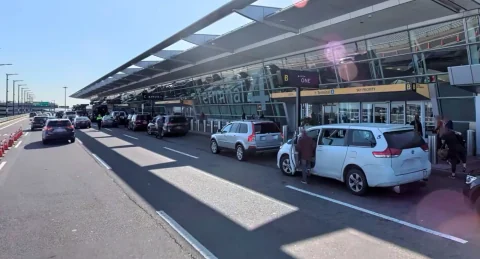
JFK car service cost depends on pickup direction, terminal, vehicle class, passenger and luggage count, wait policy, toll treatment, airport access fees, congestion-related charges, date, and whether the trip is a simple transfer or part of an hourly schedule. The useful comparison is not just private car vs taxi; it is private car vs the full JFK taxi surcharge stack, rideshare pickup uncertainty, and public-transit transfer friction.
Published by Artisan editorial & operations · Reviewed
Private car service makes the most sense for JFK when the value of a confirmed vehicle, confirmed terminal-side pickup, and a direct no-transfer drop outweighs the cost difference versus taxi or transit. That threshold is lower than it sounds for travelers with multiple bags, a group, a business obligation, a late-night arrival, or a destination that requires an intermediate transfer on public transit. The quote names the terminal (T1, T4, T5, T7, or T8), the vehicle class matched to passenger and luggage count, the wait policy for delayed flights, how tolls and CRZ pass-throughs are handled, and the meet-point — curb, arrivals hall, or meet-and-greet inside — before the traveler lands. Nothing is improvised at the curb.
— Good fit
·The traveler has checked bags, car seats, sports equipment, or a group of three or more.
·The destination is a Manhattan hotel, office building, doorman residence, or event venue.
·The arrival is late-night, early-morning, or on a flight with a known delay history.
·The pickup needs to be terminal-specific — JFK's eight terminals are spread across a loop road and vary in curb structure.
·A quote with vehicle class and wait policy confirmed before departure is required.
— Usually not a fit
·The traveler is alone with carry-on only and the destination is near a Jamaica LIRR or Howard Beach A-train stop.
·The destination is within walking distance of a Manhattan subway or LIRR terminus.
— Vehicle fit
Sedan: 1–2 passengers with light luggage
SUV: 3–5 passengers, checked bags, families, or car seats
Sprinter: 6+ passengers or group luggage
§ 02— SHORT ANSWER
The decision layer
This guide should help a traveler choose the right option quickly, then move into a quote when the itinerary needs control over pickup, vehicle class, and handoff.
Best overall
Private car service when the trip needs a quote, terminal-aware pickup, and vehicle class confirmed before the flight lands.
Cheapest
AirTrain plus subway or LIRR is the lowest-cost option for travelers with light luggage and flexible timing.
Fastest
Private car or taxi off-peak; AirTrain plus LIRR can be competitive when Van Wyck traffic is heavy.
Best for luggage
Private car service — vehicle class is confirmed in advance against passenger count and bag count.
Business travel
Private car service when the pickup needs to be terminal-aware and the destination is a hotel, office tower, or doorman building.
§ 03— OPTIONS COMPARED
Every realistic option compared
The important comparison is not just price. It is the tradeoff between cost, luggage friction, pickup control, and how much of the final handoff can be planned before confirmation.
Costs and timing reflect public source data and operator-network planning ranges; the quote states inclusions and pass-through variables before confirmation.
01
Private JFK car service
Quote names terminal, vehicle class, wait policy, toll and CRZ treatment, and meet-point before the flight lands.
Time
30–60+ min depending on terminal, route, time of day
Cost
Use the booking form to see the fare for your trip.
AirTrain 8–10 min, then subway 30–60 min or LIRR 35–55 min to Penn/Grand Central
Cost
AirTrain fare plus subway or LIRR fare (lowest-cost option)
Best for
Lowest-cost / light-luggage travelers
Weakness
Transfers and final-mile friction; not luggage-friendly
§ 04— OPTION-BY-OPTION
When each option wins
Private car service
Private car service is the cleanest JFK structure when the trip needs one accountable pickup and a direct drop to Midtown, Lower Manhattan, the Upper East Side, or a doorman building. The quote should confirm terminal, vehicle class, wait policy, toll and CRZ treatment, passenger count, luggage count, and meet-point before the traveler boards the inbound flight. Flight tracking means the driver monitors the arrival and adjusts for early or delayed landings. This is strongest for business travel, families, late-night arrivals, travelers with checked bags, and anyone whose destination is a hotel or office that expects a named handoff.
Yellow taxi (TLC $70 flat fare)
TLC §58-26 sets a $70 flat fare for all trips between JFK and Manhattan. That $70 is not the out-the-door cost. On top of the flat fare, riders pay the $0.50 MTA State Surcharge, the $1 Improvement Surcharge, a $5 rush surcharge for trips 4–8 PM, the NYS Congestion Surcharge, the MTA CRZ pass-through for trips into the Central Business District at or below 60th Street, a $2 PA pickup access fee at JFK, tolls on bridges and tunnels used, and gratuity. A typical JFK-to-Midtown yellow taxi run lands in the $95–$120 range out-the-door depending on timing, route, and tip.
Rideshare (Uber/Lyft)
Rideshare apps provide on-demand dispatch but add variables that matter at JFK. Pricing is dynamic and the app cost at pickup may differ from the estimate shown when the traveler was still in the terminal. HVFHV trips into the Manhattan Central Business District carry a $1.50 CRZ charge. Terminal 4 has time-of-day curb rules that affect where and when app-dispatched vehicles can stage. Vehicle fit is not pre-confirmed, which matters for group travel or checked bags.
AirTrain + subway or LIRR
AirTrain connects all JFK terminals to Jamaica Station (for LIRR and E/J/Z subway connections) and Howard Beach (for A train). The ride to Jamaica typically takes 8–10 minutes. From Jamaica, LIRR reaches Penn Station in roughly 35–55 minutes depending on service; the E train to Midtown takes 30–50 minutes depending on time of day. AirTrain plus LIRR is the lowest-cost structured option after the subway, and LIRR travel time can be competitive with driving on the Van Wyck during peak periods. The limitation is luggage friction across platforms and the final-mile gap between the train station and the actual destination.
§ 05— ROUTE NOTES
What we check on this route
TLC §58-26 sets the JFK flat fare at $70; the surcharge stack — MTA, Improvement, rush, NYS Congestion Surcharge, MTA CRZ pass-through, PA pickup fee, tolls, and gratuity — adds substantially to the out-the-door cost.
The Port Authority charges a $2 taxi pickup access fee at both JFK and LGA; this is separate from the TLC flat fare and applies per trip.
Terminal 4 has time-of-day curb-access rules that affect app-dispatched rideshare staging; private car service with a pre-confirmed meet-point avoids that variable.
The MTA CRZ applies to trips entering the Manhattan Central Business District at or below 60th Street; the per-trip charge differs by vehicle class (yellow taxi, FHV/HVFHV).
Use the booking form to see the fare for your trip. Concierge-quoted itineraries price above those floors depending on destination, terminal, wait policy, and CRZ pass-through. A yellow taxi runs $70 flat plus surcharges, fees, and tip — typically $95–$120 out-the-door for a Midtown trip.
Is the $70 JFK taxi flat fare the full cost?
No. The TLC $70 flat fare is the base. On top of it, riders pay the $0.50 MTA State Surcharge, the $1 Improvement Surcharge, a $5 rush surcharge for 4–8 PM trips, the NYS Congestion Surcharge, the MTA CRZ pass-through for CBD destinations, a $2 PA pickup access fee, applicable tolls, and gratuity. The all-in cost for a typical Midtown trip is $95–$120 depending on timing and route.
Is JFK car service worth it over taxi or rideshare?
It depends on the trip. For a solo traveler with carry-on only, the value case is weaker. For a group with checked bags, a late-night arrival, a hotel or office handoff, or a traveler who needs vehicle class and wait policy confirmed by email before the flight lands, private car service removes variables that taxi queues and rideshare apps do not.
What changes the JFK car service quote most?
Vehicle class (sedan vs SUV vs Sprinter), passenger and luggage count, terminal assignment, wait policy for delayed flights, toll and CRZ treatment, time of day, and whether the trip is a single transfer or part of an hourly as-directed schedule. Each of these should be confirmed in the quote before the trip.
Which JFK terminal has the most pickup restrictions?
Terminal 4 has time-of-day curb-access windows for app-dispatched rideshare vehicles. A pre-arranged car service with a confirmed meet-point — curb or arrivals hall — avoids the staging uncertainty that applies to on-demand app pickups at T4.
— Book now
Book your chauffeur
Route and pickup time first — eligible trips show vehicle classes priced side by side, with the trip total before checkout. Itineraries that need planning are prepared personally by the concierge desk.
Published by Artisan Chauffeur and reviewed by its editorial and operations team. Operational claims are tied to the sources listed for this guide; commercial details remain subject to the written booking confirmation.
Metropolitan Transportation Authority · Accessed May 3, 2026
Supports: All JFK public-transit routes use AirTrain for the airport leg AirTrain JFK connects to all terminals and to Jamaica Station for LIRR/subway transfers (+1 additional cited claims)
Metropolitan Transportation Authority · Accessed April 25, 2026
Supports: AirTrain JFK serves all terminals from the Howard Beach (A train) and Jamaica (LIRR / E / J / Z) stations LIRR-to-Jamaica-to-AirTrain is the primary public-transit path from Long Island to JFK
Port Authority of New York and New Jersey · Accessed April 25, 2026
Supports: Phased schedule approved by the Port Authority Board on December 18, 2025 Effective March 15, 2026: $3.50 FHV pickup, $3.50 FHV dropoff, $2.00 taxi pickup (+3 additional cited claims)